The Only Brand Development Strategy You Need

In this article, I want to discuss the challenge of branding and the necessary steps to establish the best brand possible. To prepare, I took a look at what others are saying on the internet about it. The insights didn’t surprise me much. I found most of those “guides” to be quite superficial, so I wanted to delve deeper here. Feel free to let me know if you think I’ve succeeded or if I should go into more detail.
Table of Contents
To begin with, what sets good branding apart from the bad, and when is the right time for branding? The timing is straightforward: it’s best to prioritize good branding from the start, but it’s never too late to begin. The key is to take the topic seriously and allocate the necessary time to achieve a good result.
What defines good branding?
In my opinion, it’s the authenticity and competence that harmonize to create a strong presence. Like a finely tuned instrument.
When building a strong brand, following the Brand Resonance Model and the four steps of brand building is helpful:

You’ll notice that the steps in my guide also fit within this model. It’s important for me to clearly convey the key points to you, so let’s get started.
Step by Step
What type of product?

Are you marketing an existing product or service, or are you branding a person? That should be the first question in the branding process. It’s important to be absolutely sure about what you’re selling in the initial step. While it may seem obvious, I believe it requires more awareness. By that, I mean you need to know what the main purpose is. Are you selling a feeling, or do you have something entirely innovative?
In my opinion, branding a person is easier, especially nowadays. This is because many consumers are bored with corporations and are overstimulated. In contrast, it makes sense that individuals can bring a breath of fresh air. Nonetheless, when it comes to branding, it’s even more important to delve into Step #3 more deeply.
There are also differences in branding a product. Software needs to be branded differently from a physical product. This is primarily because a physical product allows the customer to engage more senses in the purchasing decision. This aspect should definitely not be underestimated and serves as an example of why it’s important to understand what type of product you’re dealing with and the advantages and disadvantages associated with it.
Audience, competition and goals

Who do you want to address, or more importantly, who needs your product? Take enough time for research here and answer the most important questions:
- Who are the potential customers you can most easily sell to?
- Who are your most well-known competitors?
- How do your potential customers communicate, what are their interests, and in what tone do they express themselves?
Try to categorize your target audience as follows:
Demographic: Age, gender, marital status, location, household size
Socioeconomic: Education level, profession, income
Psychographic: Attitudes, desires, values, lifestyle
Buying behavior: Price sensitivity, satisfaction, media usage
The more you know about your target audience, the better you can tailor your brand to appeal to the buyer persona. When defining the target audience, make sure to banish the word “All.”
This word indicates that the target audience has not been defined precisely enough, and you’re only scratching the surface with this part.
Now, a quick check: Are your goals regarding your brand and product suitable for this target audience?
If you have trouble defining your goals, try the Headstand Method. This involves reversing the process of achieving a goal. In other words, start from the “end state”—what does the perfect end result look like for you?
Be very detailed about it.
Once you have the picture in mind, work backward and crystallize each step necessary to achieve this end result. When you reach the end, congratulations, because you’re also at the starting point, and you should now have a list of your goals. Go through the list again and make refinements where needed to optimize or clarify. With this list, you can determine if your goals align with the target audience and if they give you a place among the competition.
What kind of person are you?

I know this topic troubles many for various reasons. On one hand, there are too many wannabe mindset gurus who distort the actual goal behind it.
On the other hand, many people don’t want to confront themselves. I know this; trust me, and I understand it to some extent. Personally, I consider personal development one of the most important things in life, and I notice the differences between people who work on themselves and those who don’t. So, I believe this topic is also essential in the context of branding. It’s about awareness, authenticity, and trust in the cause. You can see all of these aspects in yourself or your brand, either in the short or long term. Moreover, it significantly simplifies your handling of your brand, company, customers, and unique selling points when you know what you’re talking about.
This means you need to ensure that you are consciously aware of yourself and therefore know your strengths and weaknesses 100%, and know in which situations you can shine. The question of how to achieve this state is rather difficult, as it is also very individual. But I believe the best approach is through books.
So here are a few personal suggestions that I recommend you take to heart, so you can unleash your full potential on a personal and professional level:

- “The Big Five For Life” by John Strelecky
- “Power” by Robert Greene
- “Rich Dad Poor Dad” by Robert Kiyosaki
- “The Way Of The Wolf” by Jordan Belfort
I know most people are focused on reaching their goals quickly, but let me tell you, there’s a reason why good things take time. So, take the time to engage with this topic, and one thing I promise you is that personal development will definitely take you to the next level, and, staying within context, massively strengthen your brand.
Just to be clear, it’s about control.
The better you know yourself, the more control you have. This is also what makes a good brand: it’s 100% aware of its own personality, can leverage its strengths and weaknesses perfectly, and therefore has a large part of the control over its image perception.
Let’s see if you’ve understood.
Here’s a question for you:
What are the USPs?

Unique Selling Points can be quite tricky for most people. I say this because I often notice that most individuals choose things that are either obvious or nothing special. For example, “Excellent customer service” or “Customers are our focus” – just having to write those makes my headache.
I, too, struggled initially to delve into the topic of USPs, but over time, I’ve come to realize how crucial it is and that it should never be underestimated. Now, to specify, how does one find a truly great Unique Selling Point? There are various ways:
- Through a story that others can relate to and feel addressed by. It’s mainly about a good story conveying authenticity and highlighting a brand’s competence.
- Through a specific function, whether it’s a service, program, or physical product. If you can offer a function that no one else has, it makes your product unique. If it’s a function that exists with competitors but yours is much better, then it becomes challenging. While convincing someone of quality isn’t impossible, it’s not immediately a USP on the first sight.
- The user experience can also create a significant USP. Even if something already exists, it doesn’t mean it can’t be executed better. This applies to both appearance – if a product looks more appealing – and the feeling during use, such as if a program’s user interface is much more intuitive than the competition’s.
- Offering additional services can be a significant USP. Customer interaction doesn’t end after the sale; offering additional content or goods that come with the service can give customers a sense of “getting value for their money,” which is increasingly appreciated nowadays.
- Quality can make a big difference in today’s fast-paced world. While the cheapest price used to be the most appealing, quality standards in society have generally declined. However, there are now more people craving quality goods, and they appreciate products that last longer or become more reliable due to their high quality.
- Membership can drive desire. If the prospect feels that owning your product makes them part of a special group, that’s a powerful lever. Gucci is a good example; for a while, owning Gucci products was considered a must-have among the rich.
- The variety of customization can also be enticing. Many things are very standardized, so the option for customization is often lost. However, many people appreciate products tailored to them and their personalities. I can’t recall the name, but I remember a perfume brand that created individual perfumes for customers based on their character in face-to-face meeting. In my opinion, an amazing unique selling point.
- The problem a product or service can solve can also be a USP. Since every individual problem has a solution, a solution can also be unique and make your brand stand out in the market.
- Pricing strategy is a topic in every business, and it can also create a unique selling point. If your solution is less expensive compared to competitors without sacrificing quality, it becomes interesting for both B2C and B2B.
- More efficient solutions can make existing products or services stand out because, as mentioned earlier, not every product is the same. If your product works faster, better, and more reliably than the competition’s, you can still be unique.
- Sustainability has been so overdiscussed in recent years that I feel a certain fatigue about it. Nevertheless, it’s still a highly relevant topic, and if there’s a product in that area that implements a certain level of sustainability, it can be interesting to a lot of people. I also don’t want to neglect to say that this is an enormously important topic for the future. Embracing a sustainable approach doesn’t hurt and should always be followed.
- Flexibility we can offer our customers can also provide a more relaxed way to use the product. Who doesn’t like flexibility in daily use? Nobody feels comfortable committing to a 12-month subscription or a 10-year contract, for example. We want flexibility, and if it’s not there, it can negatively impact our decision-making process, possibly leading to a “No”. Not a “No” to the product, but a “No” to the terms. Therefore, flexibility is a powerful lever as a unique selling point.
So, be specific in defining your USP and conduct surveys to ensure that your unique selling proposition is attractive to the target audience. Try using the Elevator Pitch strategy, which is usually used primarily in job application processes. Take 30 seconds to explain your USP. In that time, your opposite should understand what makes your unique selling point stand out and whether it gets their interest.
USP and Authenticity

Now that you know who you are, who your brand is, and what your absolute unique selling point is, you need to bring it all together. As I mentioned in my first blog article, “What is branding all about?” patience is key at this stage. We’re still before the use of logos and the creation of a name. Initially, we’re trying to put our emotions and approach into words to reach our target audience.
Most USPs can be tied to a brand through an authentic story, good old storytelling. So, I recommend first considering whether you can connect your unique selling point with a story about yourself or your brand. Search thoroughly but stick to the truth.
What story do you have to tell? And feel free to infuse it with your passion. Perhaps there’s a story that emerged during direct customer interaction? The goal is to show that this product fits you and your brand and what drives your motivation.
Finding the Name

Now, let’s move on to creating a name. First, a few formalities to spare you frustrations. Ensure that the name is available for a website, domain, and possibly social media profiles. Checking international trademark protection doesn’t hurt either. This is just a personal tip, as I’ve met many who did this as a last step and weren’t quite satisfied with the result, leading to spontaneous name changes.
In essence, the name should be short, memorable, and fit the essence of your brand. This requires delving into how you could best describe your brand in the form of a name. Also, don’t forget to view it from your target audience’s perspective and check for compatibility. Surveys can also help ensure that it’s not just your opinion represented. Keep asking yourself, “If a stranger reads the name, can they understand what my company is broadly about?” Also, leave room for growth so that your brand can adapt to future products.
Visual Presence

Now, move on to choosing colors that represent your brand. For starters, I recommend defining at least two types of colors: primary and accent colors. Test these colors by using them in graphics or in a trial version of a website to check the appearance. Be strict and consider which emotions the colors evoke in you. Again, it’s a good idea to involve outsiders’ opinions. Also, consider the psychological aspects of colors and which instincts they trigger:
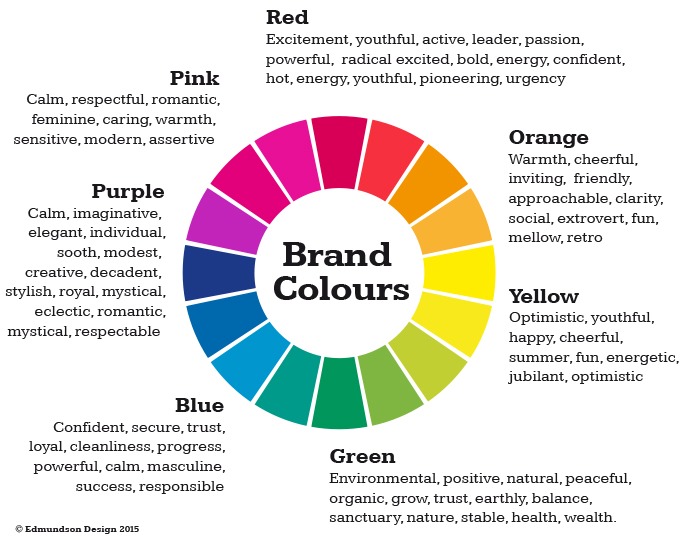
Capture all of this in a corporate design document so that all information regarding the visual design and representation of your brand is in one place. This is now the branding manuscript of your company and defines your brand identity.
The Logo

Here, we’re talking about the tool to translate the message into an image for outsiders. The logo and the representation of visual presence are essential, and here, you can truly express your brand and passion. Start with the logo and think about the direction it should take. Which strengths of your brand or characteristic features do you want to reflect in the logo? What type of logo would best suit: minimalist, typographic, playful, detailed, etc.? Keep it simple; most people prefer it small but nice.
There should also be different versions of the logo, as it needs a different layout depending on its use. For example, you need a completely different logo for your website than for the favicon. If you don’t want to design the logo yourself, it’s worth hiring someone for it. Just ensure that the person is well aware of your expectations, desires, and details so that the result can be satisfying.
Creating the Brand Voice

Without complicating matters, the brand voice is how you want to communicate as your brand and how you want to be perceived. It combines brand wording and tone into a clearly formulated description.
For those thinking, “Who needs something like that?” It’s important to ensure that customers are treated the same way and that the brand is perceived consistently across all platforms, whether it’s outward or inward communication. Regardless of whether the customer interacts with customer support, the CEO, or social media profiles, the brand voice should be consistent, and the customer should be able to recognize the brand in it.
How to do this is quite simple: look at your target audience and ask yourself how they want to be addressed. Also, ensure that your brand voice is documented in the brand identity.
Conclusion
Once you’ve completed these steps, you should have a very nice concept of your brand. Give it a final polish and check everything in detail. Have all points been fully implemented to your satisfaction?
If yes, great. If not, take the time to work on it again; it won’t hurt. The more dedication you show here, the better your brand and strategy will resonate. It’s an investment in the future of your business.
Subsequently, tailor your marketing strategy according to your brand, fine-tuning both the visual presence and communication. Always stay true to the brand voice and ensure that your values are clearly communicated.
But for those who think the work of branding is done here, I must disappoint. A good brand needs constant care.
It’s like a sports car; you need to check occasionally whether everything is as you want it, otherwise, you have to adjust the screws and undergo tests. To guarantee performance, attention to detail is necessary, and don’t hesitate to adapt the concept to the times.
There are many areas in a company where you can save money, but branding and marketing are definitely not among them.

All about branding and marketing with a focus on digital strategies. Find inspiration that helps you build your brand for long-term success.
 EN
EN  DE
DE Pages
Join The club
Get updates on special events and receive your first drink on us!
Terms and Conditions | Privacy Policy
2025 Brand Discovery. All rights reserved.